Discover
Every power chip, controller and rail on the servers you already run, found and mapped on day one.
See discovery PowerGuardBAREKET AIRequest a pilot
 The power layer beneath every AI server, finally watched. Attacks caught, crypto miners exposed, stolen keys spotted, in milliseconds.
Purpose-built for the infrastructure that cannot fail
Every new gigawatt of AI capacity arrives with thousands of power controllers nothing in the security stack defends. PowerGuard adds the missing line of defence in software, on servers already racked.
Request a pilotCore and edge sites run for years without hands on the hardware. The same measurements that catch an attack also catch power components drifting toward failure, before they take a site down.
Request a pilotRuns fully inside your environment, including disconnected networks. Machine telemetry only: no workload content, no customer data, ever. Enforcement acts under policy you set and can revoke.
Request a pilotThe power-control layer is no longer theoretical exposure. Industry research and confirmed incidents show it being probed, breached, and abused now.
Third-party incidents and research. Evidence the threat is real, not claims PowerGuard detected these.
Server management controllers reachable from the open internet, from flaws first flagged over a decade ago.
Black Hat USA 2026, runZeroState-linked group gained months-long persistent access using zero-days and rootkits.
CSIS, Feb 2026Cryptomining campaign used compromised credentials to deploy miners on cloud compute in ten minutes.
AWS GuardDuty, Nov 2025One actor escalated from mining to compromising trusted security tools and AI gateways, planting backdoors for lateral movement.
Palo Alto Unit 42, 2026NVIDIAScape: a three-line container escape grants full root on the GPU host, systemic across managed AI clouds.
Wiz, CVE-2025-23266PMFault drove voltage out of spec over PMBus to permanently damage server CPUs, remotely, no physical access.
Black Hat Asia 2023, CVE-2022-43309Every one of these ends at the same place: the power-control layer inside the server. The layer below your security stack, and the one PowerGuard was built to see.
A compromised administrator or firmware component can issue commands beneath SIEM and EDR visibility. PowerGuard creates an independent control plane for the physical power layer.
Every power chip, controller and rail on the servers you already run, found and mapped on day one.
See discoveryPowerGuard watches the power nonstop and tells normal AI load from a real attack, in milliseconds.
Explore detectionIts verdict reaches the controls you already run, only on real evidence, under the policy you define.
See enforcementPowerGuard turns invisible machine behaviour into threat verdicts that security and infrastructure teams can act on, while the evidence stays inside your environment.
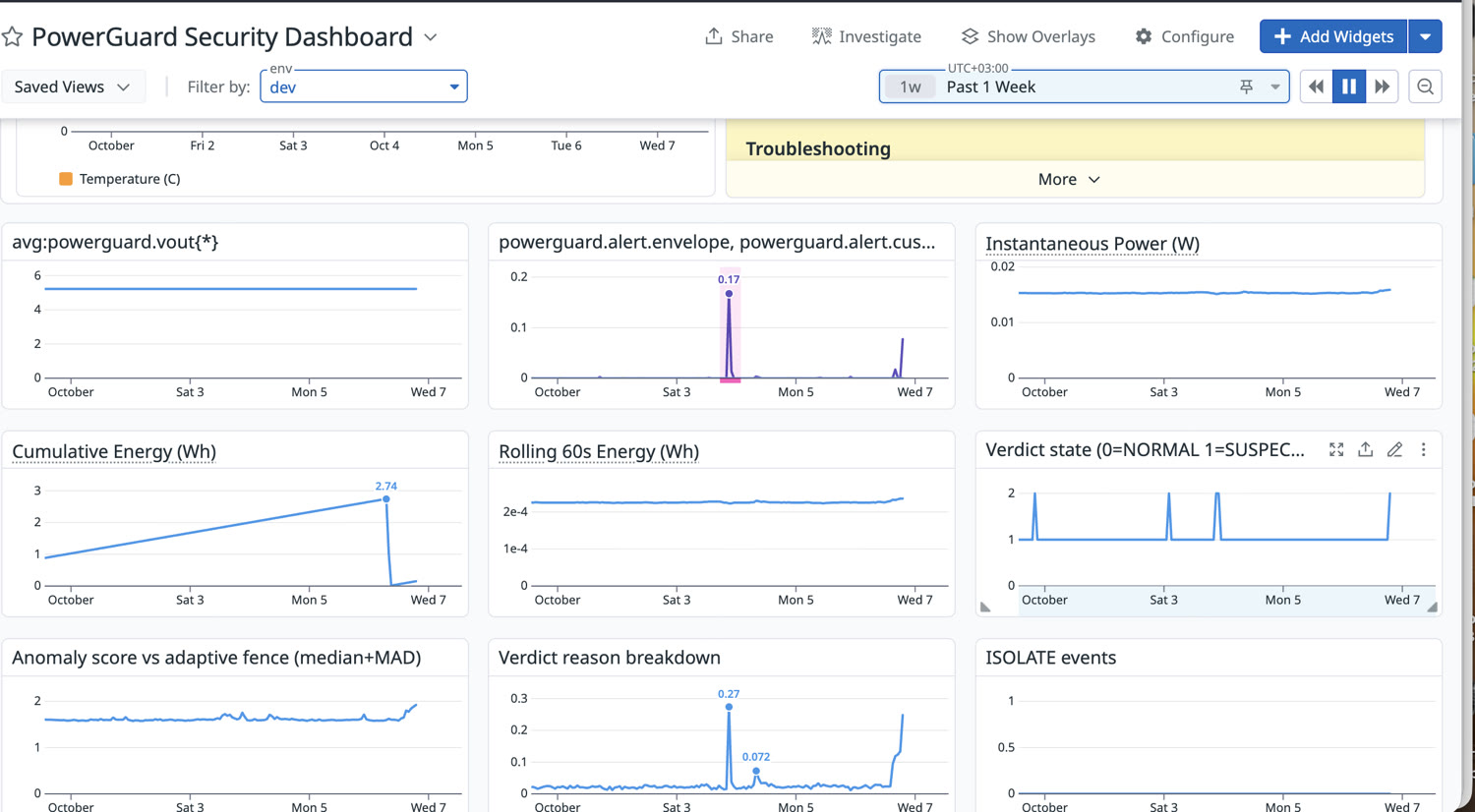
Built from real hardware research with transparent validation boundaries, not a generic anomaly engine wrapped around power data.
Measured during a physical voltage attack.
Per controller, on your hardware, no cloud round-trip.
4–6 weeks, success criteria agreed in advance.
A live command drove a physical rail outside its safe behavior. PowerGuard observed the evidence and produced a verdict in 20 milliseconds.
Map the attack surface without installing anything.
Detect in record-only mode, every verdict logged, nothing acted on.
Act only after evidence and policy are agreed.
AI infrastructure protecting AI infrastructure.
The AI is behavioural, not generative. It learns what your hardware normally does, and reports what does not fit.
A focused 4–6 week pilot on your own or production-identical hardware, with measurable success criteria agreed in advance.
Start a pilot conversation